The Paid Ads Formula
Created September 2011, from an actual NW eSource client flyer · updated August 2026. The original was titled “Sponsored Advertising Success Essentials” — eight components radiating from one hub: Setup, Performance, Conversion. That's still the whole shape of a paid search or social ad campaign that pays for itself. What changed is how fast several of the eight now run.
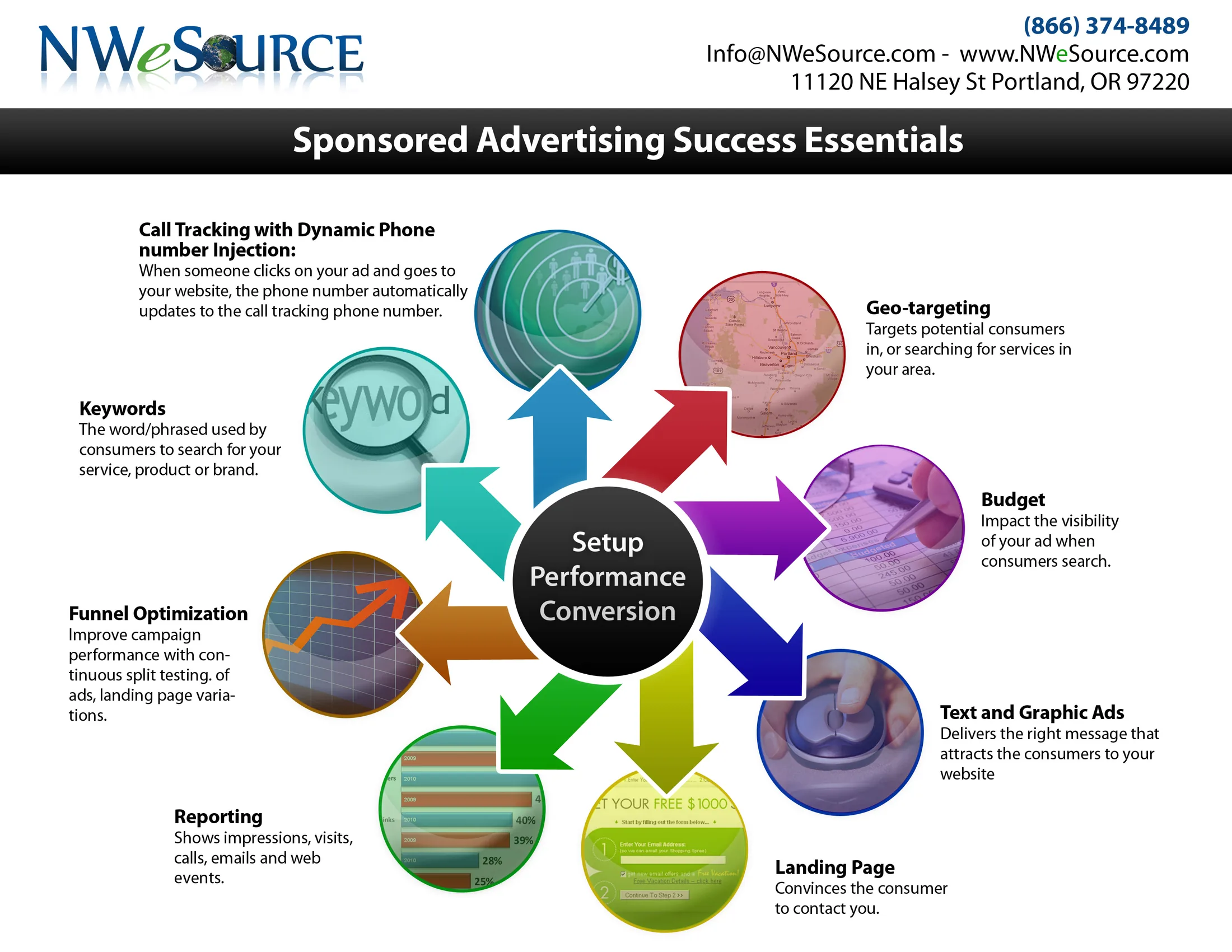
How the Paid Ads Formula works
A paid ad campaign either pays for itself or it doesn't, and the difference comes down to the same eight things it came down to in 2011. Nothing here is complicated on purpose — it's the framework we handed clients on a single-page flyer, back when a lot of small businesses were running their first search ad.
- 1 · Keywords — the words and phrases consumers use to search for your service, product, or brand.
- 2 · Geo-Targeting — targets potential consumers in, or searching for services in, your area.
- 3 · Budget — impacts the visibility of your ad when consumers search.
- 4 · Text and Graphic Ads — delivers the right message that attracts consumers to your website.
- 5 · Landing Page — convinces the consumer to contact you.
- 6 · Call Tracking with Dynamic Phone Number Injection — when someone clicks your ad and lands on your site, the phone number automatically updates to your call-tracking number.
- 7 · Reporting — shows impressions, visits, calls, emails, and web events.
- 8 · Funnel Optimization — improves campaign performance with continuous split-testing of ads and landing page variations.
From the 2011 original“Setup. Performance. Conversion.” Those three words sat at the center of the original 2011 diagram, with the eight components above radiating out around them. That's still the whole shape of a paid ad campaign: set it up right, watch how it performs, and get the consumer to convert.
The eight components, in plain English
The same eight things, in the words of the original flyer — what each one is, and why it still does the job.
1 · Keywords
The word or phrase consumers use to search for your service, product, or brand. Everything else in the formula points back to getting this list right.
2 · Geo-Targeting
Targets potential consumers in, or searching for services in, your area — so ad spend goes toward people who could actually become a customer.
3 · Budget
Impacts the visibility of your ad when consumers search. Not the whole formula — one lever among eight, and not always the one that matters most.
4 · Text and Graphic Ads
Delivers the right message that attracts consumers to your website. The ad's only job is to earn a click from the right person.
5 · Landing Page
Convinces the consumer to contact you. A great ad sending traffic to the wrong page is money spent on a click that goes nowhere.
6 · Call Tracking with Dynamic Phone Number Injection
When someone clicks on your ad and goes to your website, the phone number automatically updates to the call-tracking phone number — so a call from an ad gets credited to the ad.
7 · Reporting
Shows impressions, visits, calls, emails, and web events — the record of what the first six components actually produced.
8 · Funnel Optimization
Improves campaign performance with continuous split-testing of ads and landing page variations, using what Reporting turns up.
The original Sponsored Advertising Success Essentials flyer, 2011
This is a real client flyer from NW eSource's own archive, titled “Sponsored Advertising Success Essentials” and finalized September 6, 2011. The working Photoshop file behind it is dated July 2012 — the same document, still being maintained a year later, not a second piece. Recovered and shown exactly as it looked: eight components radiating from one hub, Setup, Performance, Conversion.
Original flyer from NW eSource's 2011 client materials — recovered from our own archive and preserved unchanged. Click the image to view it full size.
What has AI changed about running paid ads? The pace, not the parts.
The eight components on the 2011 flyer are still the eight things that make or lose money in a paid ad campaign today. What changed is how fast several of them run — from something a person checked on a schedule to something adjusted continuously.
Keywords and Geo-Targeting were two of the eight setup pieces on the 2011 flyer — a list of words and phrases and a map radius, picked once and revisited whenever someone remembered to check.
AI-assisted keyword tools surface new terms and adjust geo-targeting as performance data comes in — the same two setup pieces, refreshed automatically instead of on whoever remembered to log in.
Budget: “impacts the visibility of your ad when consumers search.” In 2011 that was a number you set and checked back on, moving it up or down by hand when a campaign felt like it needed it.
Automated bidding shifts spend toward what's converting as it happens, inside the ceiling you still set — the same lever, working continuously instead of on a manual check-in.
Text and Graphic Ads and Funnel Optimization were two separate points on the 2011 flyer — write the ad, then run a manual split test on ad and landing page variations, one round at a time.
AI-assisted ad variations and continuous testing turn those two points into one ongoing process — new variants generated and measured constantly instead of one slow round of A/B tests.
Reporting showed impressions, visits, calls, emails, and web events — a dashboard someone had to sit down and read to catch what mattered.
AI-assisted reporting surfaces what changed and why, and ties it to the Call Tracking with Dynamic Phone Number Injection point from the same flyer — so a call from an ad gets credited automatically instead of requiring a person to notice the pattern.
Paid ads, run for you — one flat price
Everything above is the framework — yours to use, free. Where we come in is execution: keyword research, geo-targeting and budget management, ad and landing page creation, call tracking setup, and the reporting and continuous split-testing that keep a campaign from going stale. One flat price, not a per-click invoice you have to interpret yourself.
Paid ads questions, answered directly
What owners ask about paid search and social ads — answered first-sentence, grounded in what the original flyer actually said.
What is the Paid Ads Formula?
It's NW eSource's eight-part framework for a paid search or social ad campaign, recovered from our own 2011 client materials: Keywords, Geo-Targeting, Budget, Text and Graphic Ads, Landing Page, Call Tracking with Dynamic Phone Number Injection, Reporting, and Funnel Optimization — all radiating from one hub the original diagram labeled Setup, Performance, Conversion. The mechanics behind several of these pieces changed since 2011; the eight pieces themselves didn't.
Is a 2011 paid-ads framework still accurate in 2026?
Yes, in structure. The eight components on the original flyer — keywords, geo-targeting, budget, ad creative, landing page, call tracking, reporting, funnel optimization — are still the eight things that make or lose money in a paid ad campaign today. What changed is how several of them get done: bidding and targeting are now largely automated, and ad and landing-page testing runs continuously instead of in slow manual rounds.
What's changed most about running paid search and social ads since 2011?
Automation. In 2011, budget and bidding were checked and adjusted by hand, and split-testing ad or landing-page variations was a slow, manual process. Automated bidding now shifts spend toward what's converting in real time, and AI-assisted tools generate and test ad variations continuously. The eight-part shape of the formula didn't change; the pace at which each part runs did.
What is call tracking with dynamic phone number injection, and do I still need it?
It's a system that swaps the phone number shown on your website for a trackable number whenever a visitor arrives from a specific ad, so a call can be credited to the campaign, keyword, or ad that generated it. It was point six on the 2011 flyer and it's still exactly as useful today — without it, calls generated by ad spend are invisible in your reporting.
Do I need a big budget to make paid ads work?
Budget is one of the eight components, not the whole formula. The 2011 flyer defined it simply: it impacts the visibility of your ad when consumers search. A well-targeted campaign with tight keywords, real geo-targeting, and a landing page that actually converts can outperform a bigger budget spent on a loose, untargeted setup.
Can I run the Paid Ads Formula myself?
Yes — it's published to be used, not sold. The eight components are all things a business owner can learn and run. Where it gets harder is the setup and ongoing management: keyword research, automated bidding strategy, call tracking implementation, and the continuous testing that keeps a campaign from going stale — that's the part most owners hand off.
One formula in a growing series.
The Paid Ads Formula joins NW eSource's set of Small Business Formulas — named frameworks recovered from our own 2011 client materials, kept current, free to use. More are on the way.
Where is your ad spend leaking?
Pick the situation that fits. Free assessment — no commitment, no pitch.
Free assessment. No commitment. No pitch.