SEO, Simply.
From NW eSource's 2011 client materials · reviewed & updated August 2026. SEO is three things: a great website, earned authority, and recency — the same three things we told clients in 2011. What changed is how you earn the middle one, and what got added for an AI-answered web. Here's the original flyer, what held up, and what we retired.
How the SEO Simply Formula works
SEO gets made complicated because complication is easier to sell. It isn't complicated. It comes down to three things — the exact three things we told clients in 2011 — plus one addition for 2026.
- 1 · A Great Website — structure, content, and calls to action a search engine, and a visitor, can actually parse.
- 2 · Earned Authority — real signals that other sources vouch for you, built honestly, not manufactured.
- 3 · Recency — fresh content and fresh signals, because an active site has always out-ranked an abandoned one.
- 4 · Get Cited by AI — the 2026 addition: being the source AI answer engines name, not just the page Google ranks.
From the 2011 original“SEO is primarily three things: #1 – A Great Website, #2 – Links to Your Website, #3 - Recency in Content & Links.” Two of those three still describe SEO exactly as it works today. The third is right in principle and was wrong in its specifics — we're not going to let that stand unchanged. More on that below.
What each part of SEO Simply actually means
The same four moves, in plain English — what it is, and what it looks like when it's working.
1 · A Great Website
The 2011 flyer broke this into eight points: keyword integration, quality structure, fresh content, content volume, visitor happiness, visitor traffic, graphic appeal, calls to action. Every one still matters. Two now have harder measurements attached — graphic appeal is Core Web Vitals and mobile speed today, not just looking nice. In practice: one honest page per service, a fast load, and a clear next step on every page.
2 · Earned Authority
The original said “links are votes that someone else in the world thinks you are important.” Still true. What changed is how those votes get earned — the 2011 tactic doesn't work anymore, and we say so plainly in the Since 2011 section below. In practice: earned mentions from review platforms, industry directories, and press — sources that reflect a real reputation, not a purchased one.
3 · Recency
Fresh Content and Content Volume were two separate points on the original flyer, because Google has always rewarded a site that's still being worked on over one that was built once and abandoned. In 2026 that same “still active” signal now also feeds AI answer engines, which favor content that looks recently verified. In practice: a content cadence you can actually sustain, not a one-time push before launch.
4 · Get Cited by AI
The move that had no 2011 equivalent, because it didn't exist yet. Ask ChatGPT or Google's AI for “the best [what you do] in [your city]” and the engine cites a handful of sources — you're in it or you're invisible. In practice: schema markup, entity clarity across your site and profiles, and answer-first content that gives an AI engine something to quote.
The original SEO flyer, from 2011
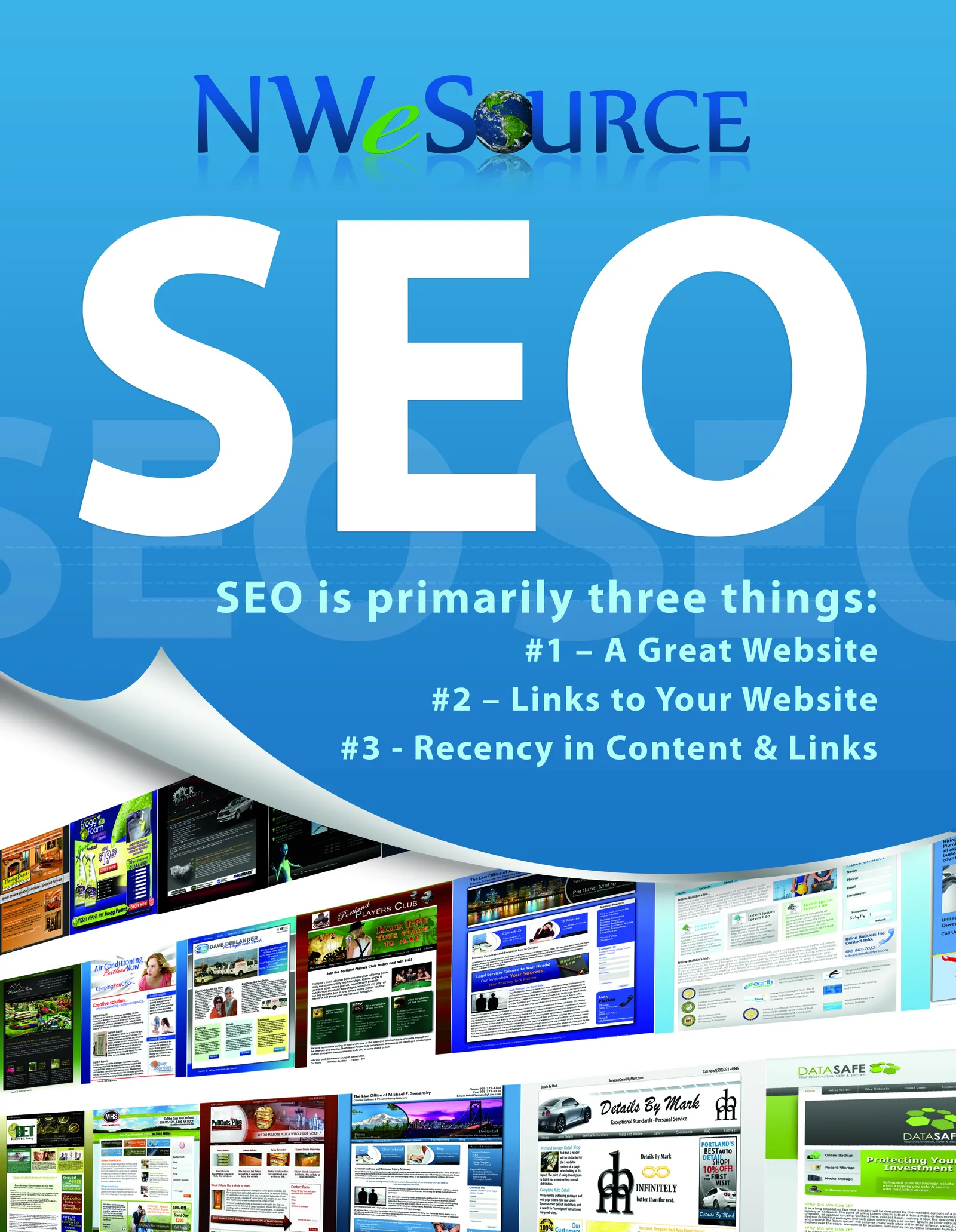
This is a printed client flyer from NW eSource's 2011 materials, finalized July 28, 2011 — the same week we finalized a companion flyer on building a great business website. Front and back, recovered from our own archive and shown exactly as they looked: a real infographic, real 2011 client sites (Frogg Foam, CR Transmissions, Air Conditioning Now, Dave Deblander, Portland Players Club, Details By Mark, DataSafe, and more), and the actual link-building plan we ran at the time. The interface is a period piece. The next section is where we tell you, plainly, which part of it we'd never run today.
Original flyer from NW eSource's 2011 client materials — recovered from our own archive and preserved unchanged. The eight-point website checklist and the “links are votes” explanation are what we've kept below. The link-building plan under “Our Solution” is what we retired — see why in the next section.
What’s changed in SEO since 2011 — and what we're retiring
We said three things in 2011. Two of them are still exactly right. The third held up in principle and broke in practice — here's the honest accounting, not a quiet rewrite.
Still true
A great website and recency in content are exactly as true today as in 2011. Structure, fresh content, and calls to action are still the backbone of SEO — Google's algorithm has changed dozens of times since 2011, and it has never once stopped rewarding a well-built, well-maintained site over a neglected one.
What we retired
Point 2 on the original flyer — build inbound links — was right. How we said to build them wasn't. See the callout below: that's the one line on this page we won't defend, named plainly, along with what replaced it.
New for 2026
Two things had no 2011 equivalent: schema markup that tells a machine what your business and services actually are, and being cited by AI answer engines — built on Google Search Console entity Associations, earned mentions, and original, sourced content rather than volume alone.
The honest versionThe 2011 flyer describes building 400 links in four months from social bookmarks, membership sites, PR article submissions, internet directories, and web forums. Read today, that's a manufactured link scheme — a fixed quota, on a fixed timeline, from low-quality sources built for the purpose. It's exactly the pattern Google's Penguin update, which arrived the year after this flyer, was built to catch. We're not going to present that as current advice, and we're not going to quietly delete it from our own history either. We said it in 2011; here's what we know now: running that tactic in 2026 risks a penalty, not a ranking. What replaced it is earning authority the way a journalist earns sources — real reviews, real directories, real press mentions, and the entity and E-E-A-T signals that tell Google, and now AI answer engines, that you're a real, trustworthy business. Slower than 400 links in four months. It's also the version that still works.
SEO, done for you — one flat price
Everything above is the framework — yours to use, free. Where we come in is execution: the website build, the authority-earning campaign done the honest way, the content cadence, and the schema and entity cleanup that gets you cited. One flat price, not a per-link invoice, and no manufactured campaign we'd have to explain away in fifteen years. Two ways to see the proof before you commit.

SEO questions, answered directly
What owners ask about SEO — answered first-sentence, no mysticism, and no dodging the parts we got wrong in 2011.
What is the SEO Simply Formula?
It's NW eSource's three-part explanation of SEO, drawn from our own 2011 client materials: a great website, earned authority, and recency in content and signals. For 2026 we added a fourth move — get cited by AI — because AI answer engines now sit above the search results. The core idea hasn't changed: SEO isn't a trick, it's being the best-built, best-sourced answer for what you do.
Is a 2011 SEO framework still accurate?
Two of the original three points are still exactly right: a great website and recency in content are as true today as they were in 2011. The third — how you earn links — needed an honest update, which is why this page names the specific 2011 tactic we no longer recommend and explains what replaced it, rather than quietly rewriting history.
Does link building still work for SEO?
Earning links still works. Manufacturing them doesn't. The 2011 version of this page described building 400 links in four months from social bookmarks, membership sites, and web forums — a pace and pattern that reads as a manufactured link scheme today, and that's exactly what Google's Penguin update, which arrived the year after this flyer, was built to catch. Running that tactic now risks a penalty, not a ranking. What works instead is earning real mentions — reviews, directories, press, and citations that reflect an actual reputation.
What is E-E-A-T and why does it matter for SEO now?
E-E-A-T stands for Experience, Expertise, Authoritativeness, and Trustworthiness — the signals Google, and increasingly AI answer engines, use to judge whether a source is credible. It's the direct successor to what the 2011 flyer called “links are votes.” The vote still counts; it just has to come from somewhere real.
How do I get cited by AI answer engines like ChatGPT or Google's AI Overviews?
Make your business unmistakable to a machine: structured data that states your services and area in a format an engine can parse, consistent entity signals across your site, Google Business Profile, and directories, and content that answers a real question in its first sentence. AI engines cite a small number of clearly-sourced businesses — the goal is to be one of them.
Do I need to publish new content constantly for SEO?
You need a cadence you can sustain, not a flood. The original flyer listed “Fresh Content” and “Content Volume” as two separate points because Google has always rewarded an active site over an abandoned one. What's new for 2026 is that AI answer engines weigh the same signal — content that looks recently verified is more likely to get cited.
Can I run the SEO Simply Formula myself?
Yes — it's published to be used, not sold. The work is in the execution: the website build, the honest authority-earning campaign, the content cadence, and the schema and entity cleanup that earns AI citations. Businesses handle pieces of this themselves all the time; where we come in is running the whole formula for one business per market, for a flat price.
One formula in a growing series.
SEO Simply joins NW eSource's set of Small Business Formulas — named frameworks recovered from our own 2011 client materials, kept current, free to use. More are on the way.
Where does your SEO leak?
Pick the situation that fits. Free assessment — no commitment, no pitch.
Free assessment. No commitment. No pitch.